Higher Education

I had an interesting discussion with a new acquaintance from England the other day, and the conversation turned to children. She had two - a boy age 19, and a girl, age 17. "Is your son away at school?" I asked, as most 19-year old's are these days.

"No," she replied in her lovely British accent. "He's a musician and composer, and he's trying to make a go of it. He had no interest in college - he just wanted to get out and do what he loved doing.   But he'll probably have to go back to England because he's much more likely to have success there than he would do over here."

I relayed my own son's similar feelings about college, and how we had felt lucky to find a  technical college dedicated to the field of study he was most interested in.

"It's all so different over here," she continued. "In England, it's not expected that everyone will go off to University. It's rather normal to get a proper job after you finish high school. Here, the kids seem pressured to go to college and all their friends are going so they want to go as well, even if they really don't know what they want to study."

I've had similar feelings about the push toward higher education ever since my son decided not to pursue the ubiquitous four-year degree.  Those feelings have intensified in the past 10 years as I've seen several young people feel pressured to attend college, and then feel like a failure when they (a) find out they can't make the grade or the payments; or (b) decide they'd rather pursue some other lifestyle path.

I was reminded of this tonight during rehearsal for the community theater group I'm working with.  In the cast of the show we're putting up, there are five young people between the ages of 22 and 30.  Each of them has a four year degree from a top state university.  Each of them was a better than average student in high school and in college.

None of them has a job.

Well, they have jobs, but they're working in restaurants or retail clothing stores or driving trucks. A few of them are lucky enough to have part-time jobs in their fields (teaching, business, city planning) but nothing that will come close to paying the rent. They also have a student loan or some other college loans which they can't repay. So before they're even established in life, they're in big-time debt.

It made me feel even luckier that my son has been self-supporting since the age of 20, and was able to buy his first home at the age of 22. He's been employed full time in his field since he finished his course of study, a program that was dedicated solely to his area of interest and focused entirely on that discipline. He was one of the lucky ones.  He knew what he wanted to do, and he went after it. However, he had no assistance from anyone at his high school.  The attitude of the counselors was "if you're not interested in four year college, we're not interested in helping you."

I think we're failing a lot of young people with that attitude.  Not everyone needs to or is able pursue higher education in the form of a four year university. Students of all abilities should be encouraged to look for viable alternatives to the traditional university experience and there should be more focused educational avenues available for people who want to prepare for a specific career.  Counselors should help young people discover their strengths and interests and guide them toward the proper educational experience, whether that's a four year college, community college, technical school, or an apprenticeship.

Unfortunately many opportunities for trades and crafts persons have been "outsourced," which has not only diminished the possibility for finding employment in those fields, but also devalued the work monetarily and in terms of status. The professional careers are supposedly "where the money's at" these days, but there seem to be too many applicants for too few positions. It's part and parcel of the polarization of our society - the rich and the poor, the educated and the ignorant, the haves and have-nots. The middle ground seems to be disappearing every day, and we all seem to be scrambling toward the high or low ends of society's see-saw.

In the end, how valuable is a higher education if you can neither pay for it nor use it?
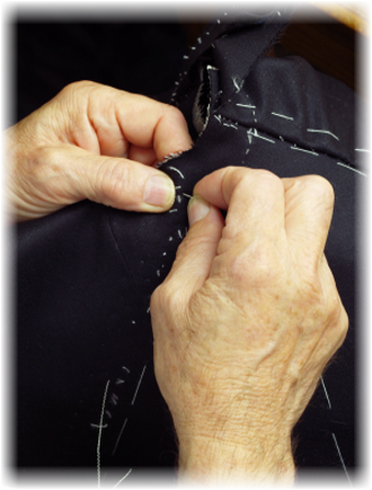
Nobody Has to See How Many Times You Rip Out the Hem

The most glorious creations seem to appear in full out of nowhere.  That's the sign of a craftsman. Creating something from nothing is a triumph of imagination and skill. When you sew a stitch, it should be so small that it disappears into the fabric, and becomes part of the whole. The smaller the stitch, the better the seamstress. I imagine words in a novel like stitches. Words should flow seamlessly, without a tug or a pull to take you out of the thought itself. ~ from Don't Sing at the Table, by Adriana Trigiani

I can't sew. In fact, I'm hopeless at anything to do with needlecraft. But there are both quilters and seamstresses in my family, and I know the value of an invisible stitch that holds the material together so it lays perfectly smooth and flows in a clean line on the body.

I also know that before the final product is spread on the bed or pulled up over the hips, there are many occasions when the stitches are torn out, the seams deconstructed, the pattern reset or the hems realigned.  This is the work that never shows, the work you never feel when you snuggle under the soft cotton backing of the quilt, or admire your silhouette in the mirror.

It's also the work you never notice when your eyes devour a page of finely tuned prose, admire a turn of phrase or a deft characterization. Don't be fooled into thinking that finished product came easily to the writer. Just like the quilter or the seamstress, the carpenter or the stonemason, the painter or the sculptor, the pianist or the singer, there are hours and hours of seam ripping behind that finished product.

The more I write, the more I understand that writing is a craft, one that must be honed and practiced, no matter how naturally gifted the writer might be.

That the results of all this hard work appear effortless in the finished product is just another sign of a job well done.

So don't be afraid to rip out a few seams in your writing today.

Surprised by Beauty

This morning I stumbled out of bed after another restless night. I first awoke at 4:00 a.m., tossed and turned for a bit, contemplated getting up but decided to stay put a while longer.  Around 6:00 I dozed off, only to be woken again by the classical music station's version of reveille - a Sousa march which they play each morning at 7:00 a.m. Very funny.

So the aforementioned stumbling began. My thoughtful husband had generously prepared the coffee, so I poured a cup and shuffled into the living room, where I was stopped dead in my tracks by the views outside my front window.

Despite the old adage about "red sky at morning...(sailors take warning)" I was mesmerized and startled out of my doldrums.

Beauty can surprise us when we least expect it. When it does, revel in it and let it energize your heart and soul.

Sleepless in Detroit

Insomnia. It started two weeks ago when I was in Florida with my friend, and I blamed it on eating too much and exercising too little.

It continued when I came home, and I attributed it to generalized anxiety about some things which I won't go into right now but which passed uneventfully.

It didn't go away until last night, and I think I've discovered the remedy.

I'm usually a very good sleeper.  I follow a strict bedtime ritual, about which I'm quite obsessive compulsive.  Here's the prescription:

  • One hour of engaging television programming (think Dancing With the Stars, Modern Family, Parenthood), enjoyed with one glass of perfectly chilled Chardonnay, followed by...
  • A hot bath, after which...
  • I climb directly into bed and tuck in with my book until I fall asleep.
This remedy has been successful for as long as I can remember.
But it hasn't been working for me lately. I've done everything according to plan, but I either can't fall asleep, or I fall asleep and then startle awake almost immediately, wide eyed and restless.  I've been tossing and turning, finally surrendering about 3:00 a.m. when I throw back the covers, get out of bed, and head off to my study to read.
Until last night.
I substituted for a friend in our church handbell choir.  I haven't played bells at church for over a year, but last night I rehearsed with both of our adult handbell groups, followed by Chancel Choir rehearsal.  So from 6:00 pm until 9:00 pm, I was making music with my friends.
Afterwards, I came home, watched some TV (Pan Am, which I have to say is very disappointing), took my bath, and slept like a baby.
Hmmm....
I've always had difficulty maintaining a balance between music and writing. Usually one or the other dominates my thoughts, time, and energy.  Since I quit working, I've been spending a lot of time alone, focusing my efforts on writing as well as some marketing activities for a new community theater group I'm working with.  There hasn't been much musical activity going on here (as evidenced by the layer of dust clearly visible on the piano bench). I've been spinning my mind in the same circles lately, so it was beneficial to send my focus in a different direction.
I think it's just as important to maintain healthy portions of the things that feed our passions as it is the things that feed our bodies. I just spent some time with a Mozart sonata to help me transition out of an afternoon fiddling with computer graphics and press releases.
Now I'm heading off to catch an episode of Blue Bloods on the TiVo.
Sweet dreams...
(wordpress is being extremely stubborn about the formatting on this post and will not do it the way I want it.  seriously annoying. )

Finding The Moment

"The story more or less comes down to a moment when something changes forever. It can be a little thing or it can be a big thing, but something that somehow reverberates through somebody's life in some ways."  ~Danielle Evans, author short-story collection Before You Suffocate Your Own Fool Self, which recently won the  PEN/Robert W. Bingham Prize for a first book.

Last week I wrote about the fear that keeps me from the page - fear of failure, fear of committment, fear of the work itself. Sometimes part of that fear is just uncertainty about where to start. Maybe I've done the research, maybe I've amassed pages scribbled sentences or scenes, maybe I have characters to die for - and maybe I don't know how to make sense of it all or where to begin.

In her interview on NPR, Danielle Evans talked about the "moment" she looks for in every story, the one that changes everything. It could be a "little thing or a big thing, but its something that reverberates through somebody's life." When she's thinking about a story, she's often thinking about "where is that moment," and "how are the other elements of the story putting pressure on it?

Pivotal moments occur not only in fiction but in nonfiction too, particularly in memoir.  There are game changing moments in every story, real or imagined. Back in my junior high school English literature class, we might have called it the "climax" of the story, the time when people react differently than you might have expected, when fate or circumstance forces them into new ways of feeling or behaving.

Finding that moment can be a way of jumping headfirst into a story or essay.  Like being tossed overboard into the deep end of the pool, you must overcome your fear and start paddling like crazy.

Before you know it, you're swimming.